

This is a Substack (mirroring a Wordpress blog) about talk in the news. Next up (after a long hiatus) is a post on prosody during President Donald Trump’s interview with the New York Times.
I interrupt that (very irregular) programming, however, with this response to the website ihatesociology.com, where you can find a compilation of quotations from academics trashing my discipline of sociology (and some offering very measured and specific criticisms who were somehow roped in), and some interviews to the same effect (again, with some exceptions). Though I’m reluctant to draw attention to the site, I felt that a response was needed. I expect it’ll be posted to the site’s comments section, which explains how it begins.
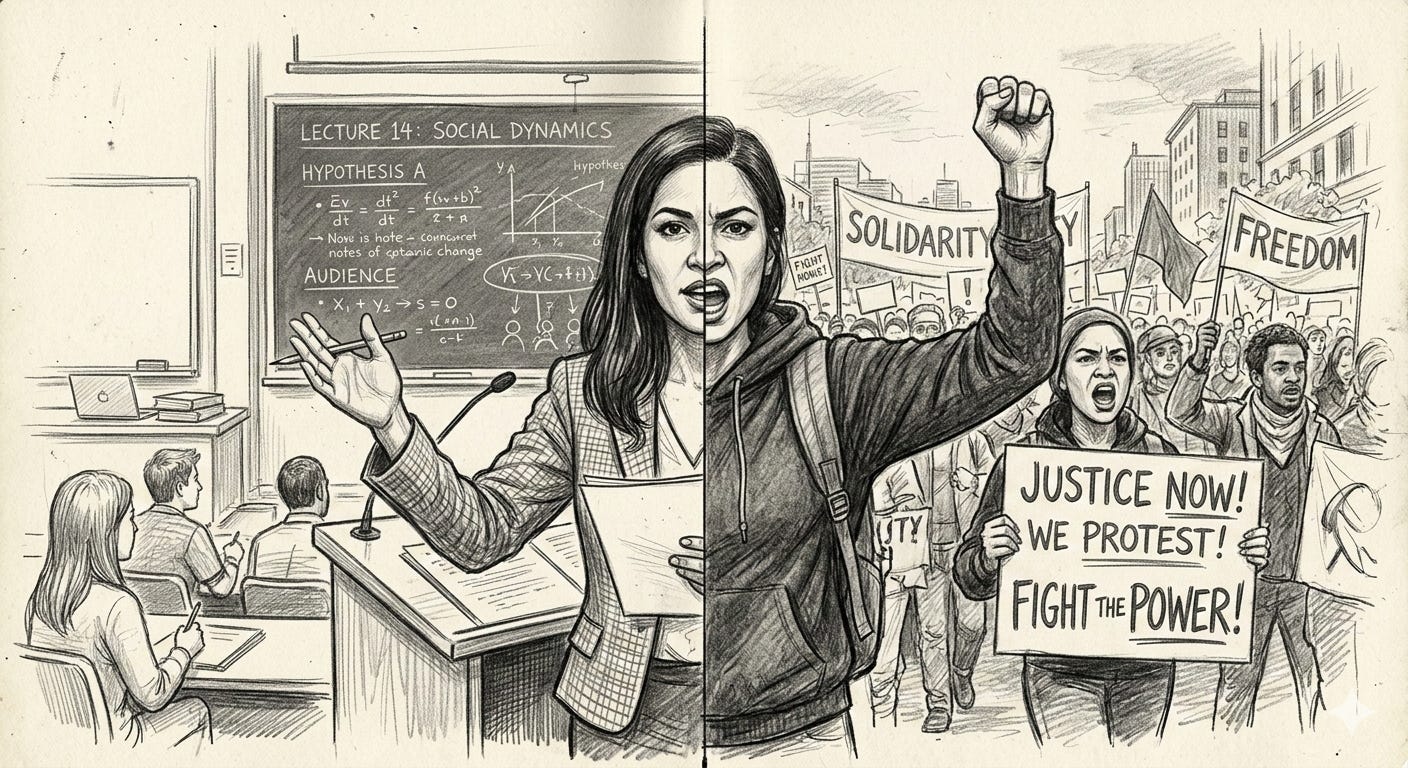
I struck up a cordial exchange with the creator of this website through Substack and he asked me to contribute a comment, though I’m reluctant to see my name here. It is admittedly disconcerting to see so many of sociology’s luminaries dissing the discipline. (Sniping by non-sociologists concerns me less.) On careful study, they have a hodgepodge of complaints and some of the people quoted might be surprised to discover that their words are being adduced in support of the “it is one of the worst majors” tagline. But there certainly is a theme common to several of them, that sociology has become too activist or left-leaning, to the detriment of the quality of published research.
I don’t want to say that they’re imagining things, much less lying, but from this site one would think that sociologists spend all of their time chanting woke slogans and flagellating people who stray from the party line. We don’t. Rather, we spend most of our time (that’s not teaching or administration or looking for parking spaces) gathering data and trying to draw conclusions warranted by said data, steering clear of known methodological pitfalls (e.g., omitted variables, social desirability, and now AI-generated survey responses), and hoping that we can claim to have discovered something sufficiently novel. Yes, it is possible that some conclusions are deemed more acceptable than others; we particularly like those that attribute life outcomes to antecedent variables that people did not choose for themselves. And over time, we’ve become more open to the perspectives of various identity groups and the scholars who, by virtue of their own backgrounds and experiences, can most effectively or most credibly articulate them.
In short, like any discipline, sociology has commitments, some of them rooted in the discipline’s (19th and early 20th century) founders and some of more recent vintage, and these go some way in explaining the discipline’s liberal leanings, which are well-documented. (Also contributing: a basic human sympathy for the people we study close-up and a kind of “let all flowers bloom” ethic that I imagine we share with scientists who literally study flora and advocate for biodiversity.) Maybe some of those impede scientific progress (Emile Durkheim did not anticipate social media or modern genetics!), and no one should be penalized for pointing that out, but most of our effort is applied to doing science.
Everyone has value commitments, and sociologists sometimes advocate for those in the public square. That could reasonably called activism, but it doesn’t impede the scientific enterprise so long as their empirical claims (e.g., about the causes of poverty or crime) are justified and they do not persist in those when new evidence suggests that they were mistaken (though, to be fair, if you persist in your beliefs sometimes it turns out you were right all along).
So what of the chorus of luminaries complaining about activism? Basically there’s a spoonful of truth and several cups of exaggeration. There are lots of reasons to exaggerate: a fit of pique, a string of bad (if atypical) experiences, an excess of nostalgia, the want of attention, the desire to make a legitimate point in the most forceful terms possible lest it get ignored. People sometimes speak immoderately, and if you search the internet for those comments you can compile a bunch of examples and create the impression that the whole discipline has been overcome by some delirium of wokeness. It hasn’t.
I appreciate your feedback. Some comments:
1. My critique/polemic does not apply to the less politicized and contentious areas of sociology, like many topics in social demography and concerning well-being.
2. Stephen Turner reached the conclusion that "the idea that sociology should be dedicated to equality and 'progressive' social change is thoroughly institutionalized. This partisanship reduces sociologists to producing 'usable knowledge' in the form of publicly understandable 'usable facts'". In a 2015 review of Turner's book, Peter Baehr argues that "rather than normalize political partisanship posing as expertise, we need to challenge and disrupt it wherever we can". The website was created in this spirit.
3. The 'progressive myths' (Michael Huemer's term) sociology is wedded to can be very harmful. They lead to failed policy, undermine the transmission of correct information to the public, increase polarization, harm the minorities that progressives claim to help, and undermine social loyalty and trust. I agree with Huemer that these are the most toxic programs one could devise to destroy society by convincing us that our society is fundamentally evil and unworthy of preservation.
4. The effect of sociology's extreme wokeness on students' educational experience and future careers do not receive enough attention. I will shortly be adding a paragraph on the woke mob denouncing yet another sociology professor, this time at small potatoes Weber State in conservative Utah. The professor dared to assign (without endorsing) an article by conservative poverty researcher Robert Rector. Multiple students wanted him disciplined. I am sick of this bs. It has gone on way too long.
5. The class schedule here (https://www.ihatesociology.com/photogallery) is from 2024 and belongs to a friend's son. His sociology courses for that term (Binghamton) were: "Social Construction of Whiteness", "Psychology of Racism", "Migration Citizenship and Human Rights", and "Social Justice". Pure propaganda. He took a woke advocacy job after graduation - convinced of the rightness of his analysis and solutions. A young man with a potential for a promising career turned into a Useful Idiot. Someone has to call this out.
Thanks for writing this.
I’ll say that individual people have agendas and political commitments and that’s normal and fine. It is not fine when the vast majority of a scientific discipline has the same agenda and political commitments.
And the idea of the data supporting things is naive because the data can and is reinterpreted, massaged, and cherry picked constantly. I can take the same data and argue both 1) market economies are unfair and the people on top are oppressors, and 2) market economies are meritocratic and the people on top make the world better for the people on the bottom. Every piece of data that points to 1 can be reinterpreted and massaged to support 2, and vice versa. We can and do nit pick to death any finding that goes against our political commitments, but unthinkingly cite as fact ones that agree.
The best defense of Sociology is that all of social science and humanities suffer the same problems. We aren’t uniquely bad.